


What Is ATL Advertising? Understanding Above-the-Line Marketing
There is a reason some brands feel instantly familiar, even before you have ever purchased from them. You recognise their colours, remember their slogans, and spot them almost effortlessly across cities, screens, and public spaces. That level of visibility rarely happens by accident. More often than not, it is the result of ATL advertising.
Above-the-Line advertising, commonly shortened to ATL, refers to large-scale marketing campaigns designed to reach broad audiences rather than highly specific customer segments. The focus is not necessarily immediate sales or direct conversions. Instead, ATL campaigns are built around something much bigger: visibility, recognition, and long-term brand awareness.
For decades, ATL advertising has shaped the way major brands communicate with the public. Television commercials, radio spots, print campaigns, and large-scale outdoor advertising have all played a major role in creating household names that people recognise instantly.
Even in an increasingly digital world, ATL remains one of the most powerful tools for brands looking to establish presence at scale.
What Does “Above the Line” Actually Mean?
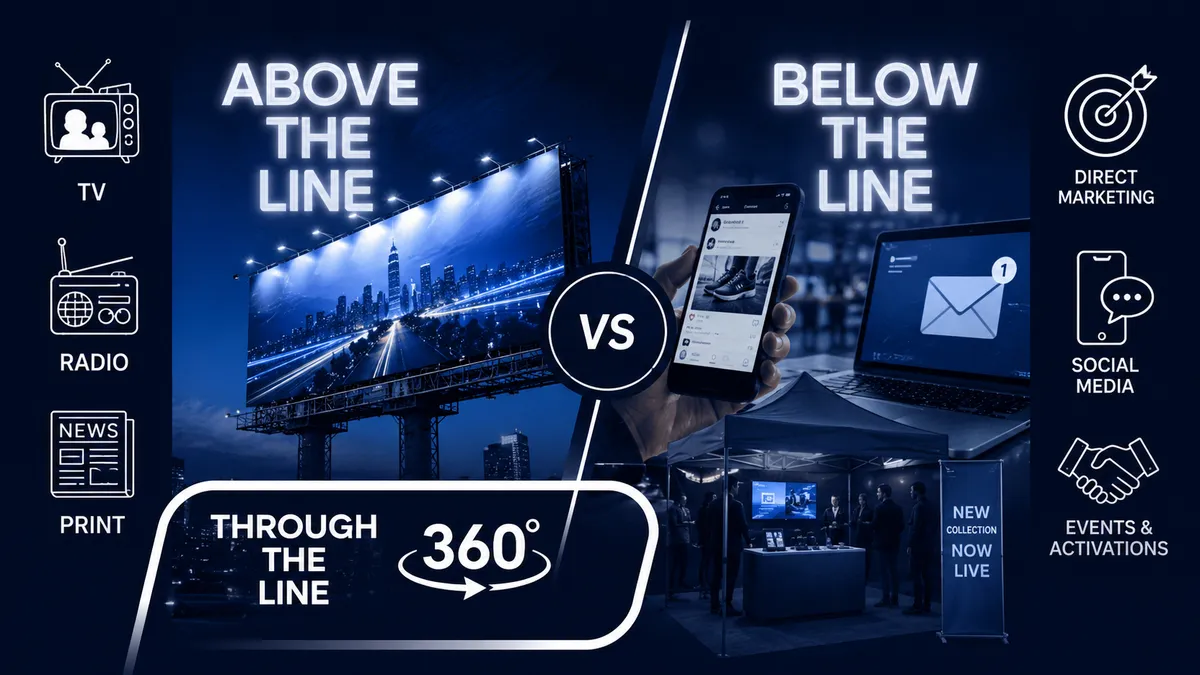
The phrase itself comes from the traditional advertising industry. Historically, agencies separated broad mass-media campaigns from more direct and targeted promotional activity using an imaginary “line”. Campaigns focused on mass awareness sat above the line, while targeted or direct-response marketing sat below it.
Over time, the terminology stuck.
Today, ATL advertising refers to campaigns that use mass communication channels to reach wide audiences across multiple demographics. The intention is not to target individuals with precision, but to create broad awareness and reinforce brand identity on a larger scale.
That is why ATL is so closely associated with channels such as television, radio, newspapers, cinema, and especially OOH advertising. These platforms allow brands to appear consistently in front of large audiences without relying on highly personalised targeting.
Why Outdoor Advertising Plays a Huge Role in ATL Campaigns
Among all ATL channels, outdoor advertising continues to hold a uniquely powerful position because it combines mass reach with real-world presence.
A television advert disappears when the programme ends. A social media ad can be skipped in seconds. A billboard standing above Sheikh Zayed Road or a branded bridge banner across a busy Dubai route behaves differently. It becomes part of the environment itself.
This is exactly why formats such as billboard advertising, bridge banners, and transport advertising are so effective within ATL strategies. They deliver continuous exposure throughout the day, helping brands build familiarity through repetition.
In cities like Dubai, where movement and visibility define much of daily life, outdoor media naturally becomes one of the strongest ATL tools available. Whether it is a taxi campaign moving through Downtown Dubai, a digital roadside screen near Dubai Marina, or airport branding targeting international travellers, outdoor advertising gives brands physical scale in a way very few channels can match.
The Main Goal of ATL Advertising Is Brand Building
One of the biggest differences between ATL and more performance-driven advertising is the objective behind the campaign.
ATL advertising is designed to build brand awareness rather than generate instant action. The aim is to make people remember the brand long before they actually need the product or service.
That is why ATL campaigns often focus heavily on:
- Emotion
- Storytelling
- Visual identity
- Prestige
- Recognition
The strongest ATL campaigns are rarely remembered because of technical product details. People remember how they felt when they saw them. This emotional connection is one of the reasons why global campaigns from brands like Coca-Cola, Nike, Apple, and Pepsi have remained culturally iconic for decades.
Outdoor advertising supports this perfectly because it allows brands to dominate physical environments in a highly visual way. A well-designed billboard or large-format digital campaign can create instant recall with only a few seconds of attention.
ATL Advertising Reaches Audiences at Scale
The defining characteristic of ATL advertising is scale.
Rather than targeting narrow audience groups, ATL campaigns aim to maximise exposure across diverse demographics. A television campaign might reach millions of viewers during prime-time programming, while a roadside billboard campaign can generate massive daily impressions from commuters, residents, and tourists alike.
This broad approach is particularly effective for:
- Product launches
- Brand positioning
- National campaigns
- Market expansion
- Building long-term recognition
The intention is not always immediate conversion. Instead, ATL creates the visibility that influences future decisions over time.
This is one of the reasons why industries such as automotive, luxury retail, real estate, finance, tourism, and entertainment continue investing heavily into large-scale ATL campaigns.
ATL Advertising Is Evolving Alongside Digital Media
Although ATL advertising is traditionally associated with television, radio, and print, the definition has evolved significantly over the last decade.
Digital screens, programmatic outdoor campaigns, and large-scale online display campaigns have blurred the boundaries between traditional ATL and digital media. Modern formats such as DOOH advertising and programmatic DOOH now combine mass visibility with data-driven flexibility, allowing brands to adapt messaging dynamically while still operating at an ATL scale.
This evolution is important because audiences themselves no longer separate channels the way marketers once did. Someone might encounter a billboard during their commute, search for the brand online later that day, and continue interacting with it through social media or video content afterwards.
The strongest modern ATL campaigns understand this journey and build awareness across both physical and digital environments simultaneously.
How ATL Differs from BTL and TTL Advertising
ATL is often discussed alongside two other marketing approaches: BTL and TTL.
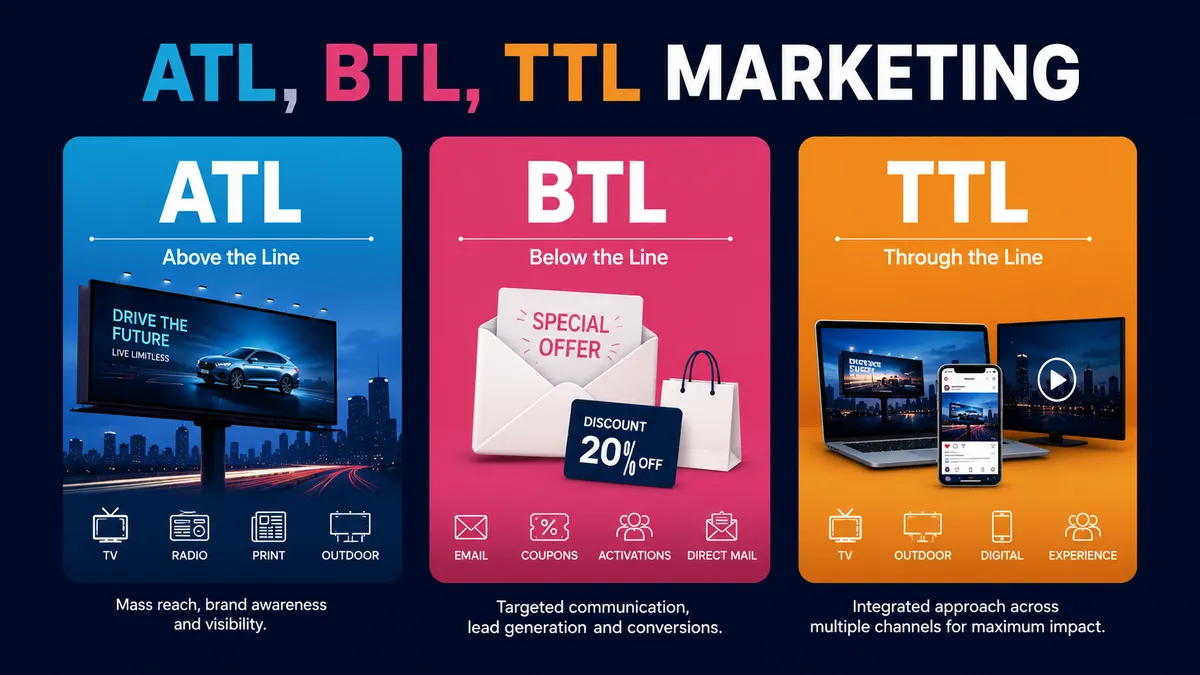
BTL, or Below-the-Line advertising, focuses on highly targeted campaigns designed to drive direct engagement or conversions. This includes channels such as email marketing, direct mail, event activations, and targeted digital advertising.
TTL, or Through-the-Line marketing, combines both ATL and BTL strategies into one integrated approach. A TTL campaign may use ATL channels like outdoor advertising or television to build awareness, while simultaneously using digital retargeting, social media, or CRM campaigns to drive measurable conversions.
In reality, many of the strongest campaigns today operate across all three approaches simultaneously.
Why ATL Advertising Still Matters Today
Some people assume ATL advertising has become less relevant in a digital-first world. In practice, the opposite is happening.
As online spaces become increasingly crowded, brands are rediscovering the value of channels that deliver unavoidable, real-world visibility. Outdoor advertising, television, cinema, and large-scale media placements create a level of credibility and awareness that purely digital campaigns often struggle to achieve on their own.
This is particularly true for Out of Home advertising, because it exists naturally within people’s everyday routines. A billboard cannot be skipped. A bridge banner does not compete with dozens of tabs on a browser. A branded airport environment creates presence in a way online banners simply cannot replicate.
That physical scale remains incredibly valuable for brands trying to stand out in saturated markets.
How Brands Use ATL Advertising in Dubai
Dubai is one of the most visually competitive advertising markets in the world, making ATL campaigns particularly impactful across the city.
Brands regularly use:
- Large-format billboards
- Building wraps
- Airport branding
- Taxi advertising
- Lamppost campaigns
- Metro and transport media
- Digital roadside screens
Formats such as lamppost advertising, unipoles, and airport advertising allow brands to dominate highly visible areas while reaching audiences from around the world.
This is one of the reasons Dubai has become such an exciting environment for ATL advertising. The city itself is built around movement, tourism, luxury, and large-scale visibility, making outdoor media incredibly effective.
Why ATL Campaigns Are Still So Memorable
The reason great ATL campaigns stay with people is because they are designed for emotional recall rather than immediate clicks.
A strong billboard, a memorable television commercial, or a high-impact airport takeover creates familiarity through repeated exposure. Over time, that familiarity turns into trust, and trust influences purchasing decisions far more than many people realise.
This is what ATL advertising has always done best. It places brands into culture, into environments, and into everyday life in a way that feels larger than a single campaign.
That ability to create lasting presence is exactly why ATL continues to hold such an important place within modern marketing strategies.
FAQs
Q1. What is ATL advertising?
ATL, or Above-the-Line advertising, refers to large-scale marketing campaigns aimed at reaching broad audiences through mass media channels.
Q2. What are examples of ATL advertising?
Examples include television commercials, radio ads, billboard campaigns, airport advertising, newspapers, magazines, and outdoor media.
Q3. How is ATL different from BTL advertising?
ATL focuses on broad brand awareness, while BTL targets specific audiences and usually aims for direct engagement or conversions.
Q4. Is outdoor advertising considered ATL marketing?
Yes, outdoor advertising is one of the most common ATL advertising channels because it reaches large audiences in public spaces.
Q5. Why is ATL advertising still effective today?
Because it creates strong brand visibility, emotional recall, and real-world presence that many digital channels struggle to replicate.
Build Large-Scale Brand Visibility Across Dubai
Whether you want high-impact billboards, airport takeovers, transport campaigns, or premium digital outdoor media, ATL advertising remains one of the strongest ways to build awareness at scale.
Explore formats, campaigns, and media opportunities with Dubai Advertising or speak with our team directly through Contact Us.
Because the brands people remember are usually the ones they keep seeing everywhere.
Get a Tailored Quote Now to Launch Your Outdoor Campaign!
Your audience is out there, on roads, at airports and across screens. Every moment of delay is a moment of lost visibility. So, why wait? Request a personalised quote now to plan and roll out your OOH advertising Dubai campaign at full speed.
We craft a bespoke strategy that delivers maximum impact across the city's most strategic locations. From concept to execution, Dubai Advertising gets your campaign up and running faster than ever.