


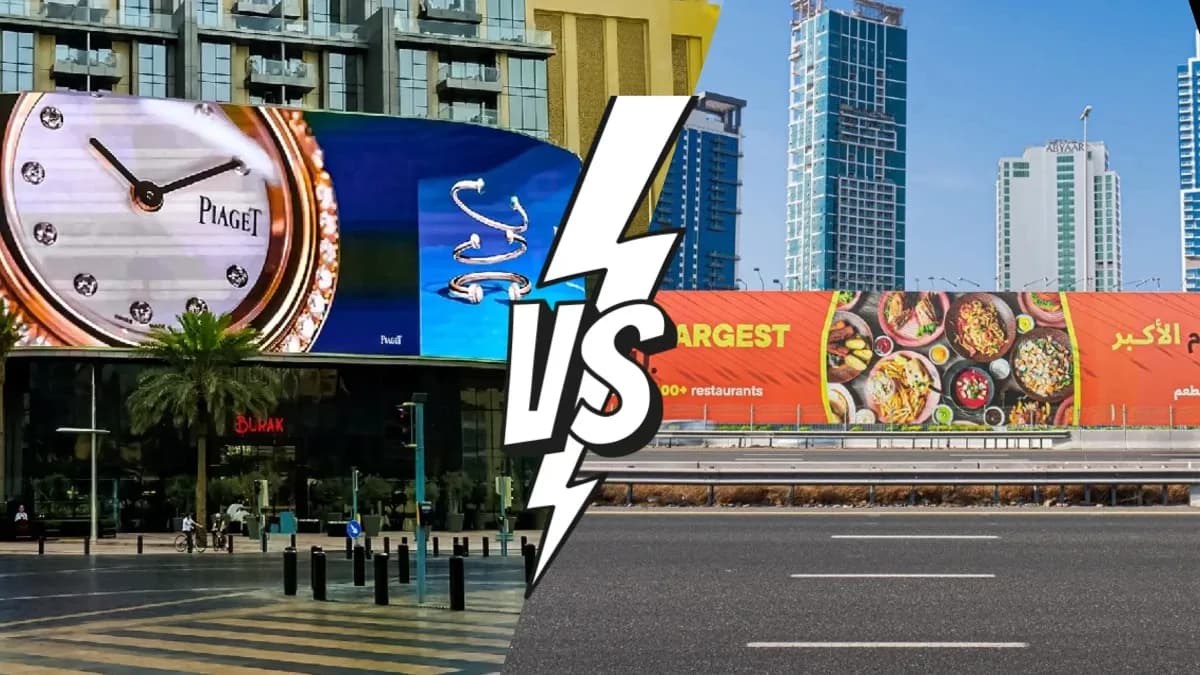
Outdoor advertising has changed dramatically over the last decade, but one thing has remained consistent throughout all that evolution. Brands still want to be seen in the real world. Whether it is a billboard towering above a busy highway or a digital screen inside a shopping mall, the goal remains the same: capture attention in places where people naturally spend their time.
What has changed is the way that attention is delivered.
Today, advertisers are no longer choosing between simply being visible or being measurable. Modern campaigns can achieve both, and that shift is exactly why conversations around OOH advertising and DOOH advertising have become so important across the industry.
Although the two terms are closely related, they are not the same thing. Understanding how they differ, where they overlap, and how they work together can completely change the way brands approach outdoor campaigns.
What OOH Advertising Actually Means
OOH, or Out-of-Home advertising, refers to traditional advertising formats placed in public spaces. It is the classic form of outdoor media that people have interacted with for decades, long before digital targeting or programmatic media buying became part of the marketing world.
This includes formats such as:
- Billboards
- Bridge banners
- Lamppost advertising
- Building wraps
- Bus shelters
- Transport advertising
Formats like billboards, bridge banners, and transport advertising continue to dominate outdoor visibility because they offer something few other channels can replicate: constant physical presence.
A traditional OOH campaign does not disappear after five seconds, cannot be skipped, and does not rely on an algorithm deciding who should see it. Once installed, it becomes part of the environment itself.
That permanence is one of its greatest strengths.
How DOOH Changed the Industry
DOOH, or Digital Out-of-Home advertising, takes the same concept of outdoor visibility and combines it with digital technology. Instead of static printed creatives, campaigns appear on digital screens capable of displaying videos, animations, live content updates, and rotating advertisements.
The environments remain familiar. Airports, malls, roadside screens, metro stations, and urban centres still form the backbone of the channel. The difference lies in how the content behaves.
With formats such as Airport Advertising and modern digital networks through DOOH advertising, brands can now adapt messaging in real time depending on weather, traffic conditions, time of day, or audience behaviour.
This flexibility has transformed outdoor advertising from something static into something responsive.
The Biggest Difference Comes Down to Flexibility
The most obvious distinction between OOH and DOOH is how quickly campaigns can evolve once they go live.
Traditional OOH is fixed. Once a billboard or bridge banner has been printed and installed, the creative generally remains unchanged throughout the campaign duration. That limitation may sound restrictive at first, but it also creates consistency. Repeated exposure to the same visual every day strengthens brand recognition and recall over time.
DOOH works differently. Content can be updated remotely within minutes, allowing advertisers to rotate messages throughout the day or align campaigns with specific triggers. A coffee brand could promote breakfast offers during the morning commute and switch to iced drinks later in the afternoon. A retail campaign could display entirely different creatives across weekdays and weekends.
This ability to adapt gives DOOH a level of agility that feels much closer to online advertising while still maintaining the large-scale visibility of outdoor media.
Why Traditional OOH Still Holds Incredible Value
With all the excitement surrounding digital screens, there is sometimes a misconception that traditional OOH has become outdated. In reality, it remains one of the strongest awareness-building channels available.
Static outdoor formats provide uninterrupted visibility. A billboard on a busy road does not rotate between advertisers or split screen time. It belongs entirely to one campaign for the duration of its placement.
That exclusivity matters.
Campaigns that rely on dominance, prestige, and constant reinforcement often benefit enormously from traditional OOH. Luxury brands, property developers, automotive companies, and large-scale consumer campaigns continue to invest heavily in formats such as unipoles, bridge banners, and building wraps because they create undeniable physical impact.
There is also a simplicity to static OOH that audiences instinctively trust. It feels established, visible, and confident in a way that purely digital media often struggles to replicate.
Where DOOH Excels Beyond Traditional Formats
While traditional OOH dominates in permanence and uninterrupted exposure, DOOH excels in engagement and adaptability.
Motion naturally captures attention more effectively than static visuals. A dynamic screen inside a shopping centre or airport environment creates movement, energy, and flexibility that static formats cannot deliver in the same way.
This is particularly valuable for campaigns that:
- Need frequent creative changes
- Rely on timely messaging
- Want to integrate video content
- Aim to drive digital engagement
DOOH also allows advertisers to incorporate QR codes, live feeds, countdowns, and interactive content into campaigns, creating a more connected journey between physical advertising and online action.
That connection is becoming increasingly important as brands build more integrated campaigns across multiple channels.
Measurement Has Improved for Both
One of the biggest historical criticisms of outdoor advertising was measurement. Traditional OOH campaigns often relied on estimated traffic and audience figures, making it difficult to track direct performance.
That landscape has changed significantly.
DOOH naturally offers stronger real-time analytics due to its digital infrastructure, allowing advertisers to monitor impressions, engagement, dwell time, and audience patterns more accurately. Programmatic DOOH platforms have pushed this even further, enabling campaigns to be optimised dynamically while they are running.
Traditional OOH measurement has also improved through location data, traffic analysis, and audience modelling, making the channel far more accountable than it once was.
The result is that outdoor advertising as a whole is becoming increasingly measurable, which is one of the key reasons brands continue shifting more budget into the space.
The Smartest Campaigns Use Both Together
The discussion should never really be about choosing one over the other.
The strongest outdoor campaigns today often combine both OOH and DOOH strategically. Static formats provide long-term dominance and continuous visibility, while digital screens add flexibility, creativity, and contextual relevance.
A brand might use a large-format billboard to establish presence across a city while simultaneously running dynamic DOOH campaigns in malls, airports, or metro networks to reinforce messaging closer to points of engagement.
That combination creates consistency without losing adaptability.
It also reflects how people experience advertising today. Audiences move through multiple environments throughout the day, and the most effective campaigns move with them.
Why Outdoor Advertising Continues to Grow
Despite the rise of digital marketing, outdoor advertising continues to expand globally because it delivers something increasingly rare: unavoidable visibility in the real world.
People can close apps, skip videos, block banners, or scroll past content online. Outdoor media works differently. It exists within physical environments where attention is often more natural and less fragmented.
This is one of the reasons why industries ranging from luxury fashion to technology, property, automotive, sports, and entertainment continue investing heavily into both OOH and DOOH campaigns. The channel offers reach, credibility, and physical scale in ways few other media formats can achieve.
As digital technology continues to reshape the industry, outdoor advertising is becoming more connected, more measurable, and more intelligent while still retaining the qualities that made it powerful in the first place.
FAQs
Q1. What is the difference between OOH and DOOH advertising?
OOH uses traditional static outdoor formats such as billboards and posters, while DOOH uses digital screens capable of displaying dynamic and real-time content.
Q2. Is DOOH better than traditional OOH?
Neither is universally better. OOH offers constant visibility and strong physical presence, while DOOH provides flexibility, targeting, and dynamic content options.
Q3. Is DOOH more expensive than OOH?
DOOH can involve higher costs due to digital infrastructure and premium placements, although share-of-voice models often make it flexible for shorter campaigns.
Q4. Can OOH and DOOH work together?
Yes. Many brands combine static OOH with digital screens to balance long-term visibility with real-time engagement.
Q5. Why is outdoor advertising still effective today?
Because it delivers real-world visibility that cannot be skipped, blocked, or ignored in the same way as many digital channels.
Bring Your Brand Into the Real World
Whether you are looking for large-scale billboards, high-impact airport campaigns, or modern digital screens, outdoor advertising remains one of the most powerful ways to stay visible where people actually live, move, and engage.
Explore formats, campaign ideas, and media opportunities with Dubai Advertising or speak with our team directly through Contact Us.
Let’s build campaigns that people don’t just scroll past.
Get a Tailored Quote Now to Launch Your Outdoor Campaign!
Your audience is out there, on roads, at airports and across screens. Every moment of delay is a moment of lost visibility. So, why wait? Request a personalised quote now to plan and roll out your OOH advertising Dubai campaign at full speed.
We craft a bespoke strategy that delivers maximum impact across the city's most strategic locations. From concept to execution, Dubai Advertising gets your campaign up and running faster than ever.